
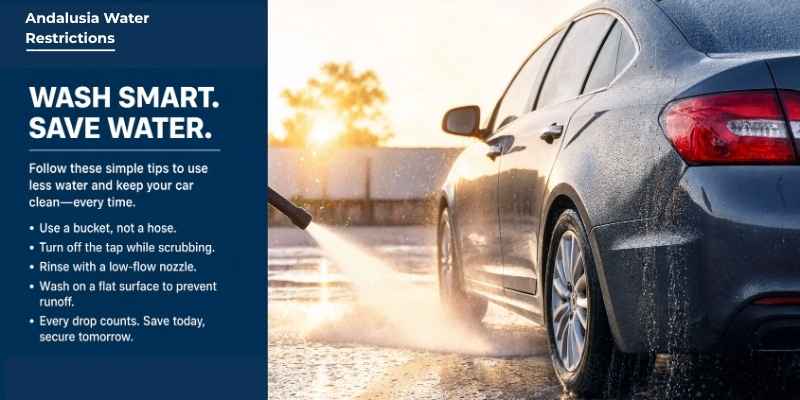
Water restrictions can make car washing surprisingly complicated. During droughts in Andalusia, local councils may limit the use of drinking water for non-essential tasks, like washing vehicles outside of authorized facilities.
However, this does not mean you have to leave your car covered in Calima dust, road grime, or coastal residue. Rules can change as water conditions improve. Always check the current local restrictions before using a hose.
This guide covers key car washing methods during Andalusia water restrictions, including the legal rules, low-water cleaning, safer ways to remove Saharan dust, professional cleaning options, and practical ways to protect your car’s paint across the Costa del Sol.
Regional Water Restrictions & Legal Limits
Water restrictions in Andalusia can change. The Junta de Andalucía adjusts measures based on drought and water-supply levels, while local councils (ayuntamientos) can set their own rules.
Right now, the Junta de Andalucía’s Order of 10 April 2026, published in BOJA on 23 April 2026, has declared that the Guadalhorce-Limonero and Viñuela-Axarquía systems are back to normal levels, ending the drought situation in the Mediterranean Andalusian basins.
In Marbella, the Western Costa del Sol system returned to normal in May 2025. However, the municipality still encourages responsible water use and warns that restrictions might return if needed.
Therefore, car owners should not assume that any past drought bans are still in effect. They should also not expect that water use will always be unrestricted. Before washing cars at home, check with your local Ayuntamiento and water supplier for the latest rules.
Understanding Regional Hosepipe Bans
In many areas, local rules (bandos municipales) prohibit certain outdoor water activities for homeowners and residents. Prohibited actions include:
- Connecting a hosepipe, pressure washer, or garden tap to the drinking water supply to wash a car.
- Washing any personal or commercial vehicle on public roads (vía pública).
- Filling or topping up non-recirculating cleaning basins using tap water.
Conversely, regional laws explicitly permit vehicle washing that uses non-potable water sources, certified zero-water eco-detailing products, or commercial facilities operating approved water recovery systems.
To explore how local town halls enforce these rules in specific coastal municipalities, read our detailed analysis on the legality of washing your car at home in Marbella.
Fines and Legal Penalties in Málaga
In Málaga province, local police and environmental inspectors monitor compliance with drought rules. Town councils enforce these rules through local water management laws (Ordenanzas Municipales del Ciclo Integral del Agua). Penalties for illegal water use are organized into three levels:
- Minor Infractions: Fines from €60 to €750 for first-time residential violations, like using a garden hose to wash a car in a private driveway.
- Moderate Infractions: Fines from €751 to €1,500 for repeated violations or washing vehicles on public streets.
- Severe Infractions: Fines up to €6,000 for serious commercial violations, unauthorized connections to public hydrants, or ignoring municipal rules repeatedly.
Waterless & Eco-Friendly Wash Techniques
Using waterless washing methods helps car owners keep their vehicles clean without wasting water. Unlike traditional washing that uses a lot of water to rinse off dirt, waterless cleaning uses special formulas made with polymers.
These high-lubricity waterless products include ingredients that quickly bond with surface dust and light dirt. The liquid surrounds dirt particles, lifting them off the car’s surface and creating a slippery barrier.
This protection stops abrasive particles from scratching the paint when you wipe them away. If you want a professional touch, booking a waterless car wash service ensures your car stays compliant with regulations and free from scratches.
Steps for Waterless Car Wash Spray Process
To clean your car without water, follow this step-by-step process:
- Work in the Shade: Make sure the vehicle is cool. Washing in direct sunlight can make the cleaner dry too fast, leaving residue.
- Spray Generously: Apply a waterless formula to one panel (like the hood) until it’s misted well.
- Use a Clean Microfiber Towel: Fold a soft microfiber towel (at least 400 GSM) into quarters to create eight clean surfaces.
- Execute Single-Direction Wipes: Gently glide the towel over the panel in straight lines. Avoid rubbing in circles. Roll the edge of the towel up as you wipe to lift dirt off.
- Buff for Shine: Use a separate, dry microfiber towel to wipe away any leftover haze, making the surface shine.
For more practical tips on adapting your home care routine, explore our resource on maintaining your vehicle during hosepipe bans.
Rinseless Wash Bucket Method
If your car is moderately dirty or has light mud, the rinseless wash bucket method is a good option. This method uses just one bucket with less than 5 liters of water mixed with a rinseless polymer solution.
- Static Conservation: This solution doesn’t need rinsing, so you don’t need a hose or extra water.
- Grit Guard Protection: Place a grit guard at the bottom of the bucket to catch heavier dirt.
- Controlled Saturation: Soak a microfiber sponge or wash mitt in the solution, clean one section at a time, and dry the panel immediately with a soft towel.
Dealing with Calima Dust During Droughts
One of the biggest challenges for vehicles on the Costa del Sol is the arrival of Saharan dust storms, called Calima. When this dust mixes with light rain, it leaves a thick layer of mineral-rich orange mud on car paint and glass.
Calima dust mainly contains fine silica, quartz, and mineral sand. These tiny, sharp particles can cause swirl marks and deep scratches if you rub them while dry.
During water restrictions, you can’t simply wash this abrasive layer off with a hose, so it’s important to use a careful chemical pre-treatment. For more details on managing these weather events, check out our guide to surviving the Andalusian Calima season.
Pre-Treating Dust Without Pressure Hoses
To remove heavy Calima accumulation without water, first soften the mineral layer with a chemical treatment before touching the vehicle.
- Spray a high-lubricity pre-soak or quick-detailer generously on the dust-covered areas.
- Let it sit for 2 to 3 minutes so the surfactants can break the bond between the dust and the clearcoat.
- Mist some extra lubricated spray directly on your cleaning cloth to help it glide.
- Clean from the top of the vehicle downwards, allowing gravity to pull the loosened particles down.
For detailed steps on removing heavy dust without causing scratches, consult our specialized guide on safely removing Saharan dust without scratching.
Protecting Paintwork From Scratches
Equipment / Technique | Recommended Protocol | Primary Function |
Towels | Premium plush microfiber (400 to 600+ GSM) | Traps grit deep within long pile fibers, keeping sharp dust away from clearcoat. |
Wiping Motion | Straight, single-direction sweeps with towel rolling | Traps grit deep within long pile fibers, keeping sharp dust away from clearcoat. |
Towel Management | Flip to a fresh folded side after every single panel sweep | Ensures dirty microfiber surfaces never contact clean paint sections. |
Lubrication Level | Keep panels visibly wet with waterless formula | Eliminates dry friction between cloth and clearcoat. |
Commercial & Mobile Wash Alternatives
During drought alerts, homeowners can’t use hoses, but commercial cleaning services have legal options that comply with regulations. Drought orders make it clear that residential water use is different from commercial usage, which follows specific environmental rules.
Commercial car washes get permits from the city by showing that they use water efficiently, treat waste properly, and manage resources responsibly.
Closed-Loop Water Recycling Systems
Licensed commercial car washes can operate during droughts because they use closed-loop water treatment systems. These systems collect used wash water through drains and send it to underground tanks, oil separators, and filters.
The water gets cleaned and reused in the washing process, recycling more than 85% of the water. Local drivers can still legally use authorized commercial fleet wash facilities by significantly cutting down on the amount of fresh water each vehicle uses.
Professional Mobile Steam & Dry Cleaners
Mobile detailing companies also provide compliant solutions for residents in apartments or areas with shared garage rules.
✅ Low-Moisture Steam Systems: These industrial mobile units use superheated dry steam, needing only 2 to 4 liters of water to clean a whole car, including the wheels.
✅ Zero Environmental Runoff: The high-temperature steam turns to vapor and removes tough dirt without leaving liquid on the driveway or garage floor.
✅ On-Site Convenience: Mobile technicians bring their eco-friendly supplies directly to homes or businesses.
Car owners who want legal on-site cleaning can book specialized mobile vehicle wash services for areas with restrictions.
Paint Protection Strategies for Dry Climates
To keep your car clean during dry weather, proactive paint protection is key. When you seal your vehicle’s surfaces, dust, bird droppings, and bug residue have a harder time sticking. This makes cleaning easier with waterless wipes.
Ceramic Coatings and Synthetic Sealants
Using a high-quality hydrophobic treatment adds an invisible protective layer over your car’s clear coat. Synthetic spray sealants and professional ceramic coatings use nano-silica (SiO₂) to fill tiny gaps in the paint.
This creates a smooth surface that repels water and stops fine dust from embedding into the clear coat. During dry spells, you can often bring back your car’s shine with just a quick spray of detailer and a soft cloth.
To keep your vehicle looking good, schedule professional car exterior washing services.
Coastal Salt and UV Damage Prevention
If you drive near the coast, like in Puerto Banús, San Pedro de Alcántara, Rincón de la Victoria, or Nerja, your vehicle faces salt from the sea and strong sunlight. This combination can harm the clear coat and dull the paint if not taken care of.
- Park in Shaded or Covered Garages: Protect your car from strong daily UV rays that can bake dirt into the paint.
- Target Coastal Salt Deposits: Use quick-detailer sprays to wipe down areas that collect salt, like the front edges, side mirrors, and rear glass.
- Maintain Trim Seals: Apply protective treatments to rubber seals and plastic trims to prevent them from drying out and cracking due to salt air.
Learn more about how coastal conditions affect your vehicle’s finish by reading our guide on the impact of coastal salt air on cars.
Caring for Your Vehicle in Costa del Sol
You can keep your car looking good and maintain its value while respecting water restrictions in Andalusia. Switch from traditional hose washing to waterless cleaning methods, use approved commercial facilities, and apply paint sealants. These eco-friendly practices will help protect your car and conserve local water resources.
FAQs About Andalusia Car Wash Rules
Can I Wash My Car at Home With a Bucket?
No, you cannot use regular tap water from the municipal supply for bucket washing during drought alerts. However, you can use a single bucket of static, non-potable water or rinseless wash products on your private property, as long as you don’t use running water and don’t let runoff go into storm drains.
Are Commercial Car Washes Open During Droughts?
Yes, licensed commercial car washes can operate even during drought restrictions. They have special water treatment and recycling systems that clean and reuse most of their wash water, meeting local environmental rules.
Will Waterless Washing Scratch My Car Paint?
No, as long as you use the right products and methods. Waterless cleaning solutions contain polymers that safely lift dust off the paint. Scratches can happen if you use dry cloths without lubrication or wipe away thick mud without pre-soaking it first.
How Do Fleet Operators Maintain Vehicles?
Car rental services at Málaga-Costa del Sol Airport (AGP) and local transport companies use automated washing systems with industrial recycling or hire certified mobile eco-detailing services. You can find out more about how commercial transport deals with water restrictions by looking into drought protocols for fleets.


