
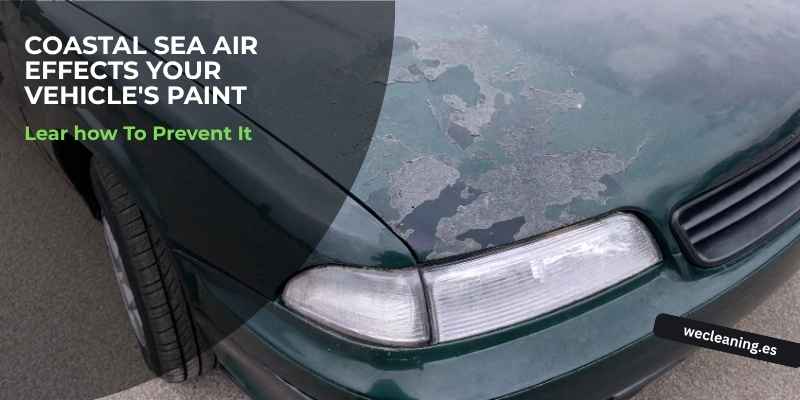
Understanding how coastal sea air affects vehicle paint is essential to protecting your car’s exterior before the damage becomes permanent. In this guide, we will explain how salt in the air harms your car’s paint and show you how to protect your investment.
We will discuss the science behind how the clear coat on your vehicle breaks down, look at local factors like Saharan Calima dust that can speed up this process, and give you practical car washing tips and professional paint repair options.
The Science Behind Salt Air and Paint Damage
Coastal air has more humidity than normal because breaking waves and sea spray release tiny salt droplets called marine aerosols. Wind can carry these particles away from the shore.
When the water evaporates, it leaves chloride-rich salt on surfaces. Modern vehicles have several protective layers: a clear coat, a colored basecoat, a primer, and an electrocoat over the metal.
The clear coat protects the layers underneath from weather damage and UV light. Salt usually does not easily pass through a healthy clear coat.
However, the risks increase with surface contamination, worn paint, stone chips, scratches, and spots like panel edges and seams where moisture and chloride can get in.
How Airborne Salt and Humidity Break Down Clear Coat
Coastal air is not just dry salt dust. Marine air carries tiny moisture droplets, known as marine aerosols, that contain dissolved sodium chloride and magnesium salts.
These salt aerosols settle on your vehicle’s clear coat. Sodium chloride is hygroscopic, meaning it can draw in water vapor from humid air, creating a constant microscopic saline film on your vehicle, even when it hasn’t rained.
- Pore Settling: Tiny salt crystals land on the porous surface of the clear coat.
- Moisture Absorption: Hygroscopic salt pulls in humidity at night and turns into a concentrated liquid.
- Thermal Expansion and Contraction: Changes in temperature cause the clear coat to expand and contract.
- Micro-Fracturing: As trapped saline moisture evaporates and crystallizes, salt crystals can break the polymer resins, forming tiny cracks and etching.
The Chemical Reaction Between Brine and Metal
When salty brine gets through the clear coat’s tiny cracks, it reaches the color basecoat, primer, and bare metal underneath. Sodium and chloride ions act as catalysts that speed up oxidation much more than inland moisture.
Chloride ions can break down protective zinc coatings on galvanized steel and cause corrosion under aluminum panels. This layer of salt creates tiny pits, weakens the paint bond, and promotes rust beneath the surface.
Signs Your Paint is Suffering from Sea Air Damage
Coastal damage usually doesn’t start with obvious signs like peeling paint or rust. Instead, early signs are often subtle, so it’s important to inspect your vehicle regularly.
Early Visual Indicators of Coastal Paint Degradation
Marine air damage builds up slowly. Spotting it early is crucial to avoid serious clear-coat failure. Before you see rust, the clear coat starts to lose its strength and ability to protect.
If you notice these early signs and prevent hard water spots on car paint, you can save your vehicle from requiring extensive dual-action machine polishing or paint correction later on.
- Loss of Surface Gloss: The paint appears flat or hazy, even right after a wash.
- Rough Tactile Texture: When you run your hand over washed panels, they feel rough, like sandpaper. This is caused by salt deposits and minerals.
- Persistent Surface Haze: A cloudy film remains on flat surfaces, especially in bright sunlight.
- Reduced Water Beading: Water from rain or washes pools on the surface instead of forming beads.
Advanced Damage: Clear Coat Failure and Surface Rust
If you don’t address early signs, the damage from coastal air can worsen. Advanced damage shows as chalky white spots, the clear coat peeling, and cracks on the hood, roof, and trunk lid.
When chloride ions get into stone chips, scratches, or seams, small rust blisters appear on steel panels. On aluminum panels, the damage looks like spider-web trails under the paint, indicating the factory primer has lost its grip and needs professional repair.
Why Costa del Sol Conditions Accelerate Paint Decay
Vehicles on the Costa del Sol face many harmful conditions that speed up paint decay. The area has salt exposure, marine aerosols, strong sunlight, heat, airborne dust, and frequent outdoor parking.
Hot Mediterranean Sun and High Coastal Humidity
The Costa del Sol has a unique climate that causes paint to degrade more quickly than in cooler northern coastal areas. The strong Andalusian sun heats vehicle panels, making the clear coat expand.
During the day, surface temperatures can exceed 50°C, which opens up paint pores and allows salt aerosols carried by easterly winds to settle deep into the paint.
At night, the humidity often rises above 80%, which dissolves the trapped salt and keeps a corrosive mixture active for hours. Weather statistics from the official Agencia Estatal de Meteorología (AEMET) show that the region has high solar exposure and consistent humidity levels.
These conditions create a cycle of heat and moisture that speeds up paint damage.
Environmental Stressor | Regional Mechanism | Direct Impact on Vehicle Paint |
Solar UV Irradiance | Over 3,000 annual sunshine hours with high daytime surface heat. | Expands clear coat pores and degrades UV-inhibiting polymers. |
High Coastal Humidity | Nighttime relative humidity regularly exceeds 75–80%. | Triggers hygroscopic salt activation, creating a liquid electrolyte film. |
Levante Winds | Onshore easterly breezes carrying airborne marine aerosol. | Deposits fine sodium chloride spray miles inland along the A-7 corridor. |
The Danger of Calima Dust Mixed with Salt Aerosols
When strong winds bring fine Sahara dust to the Costa del Sol, vehicles face an extra risk. The dust settles on damp salt spray and forms a gritty, mineral-rich mud.
If you wipe this mud off with a dry cloth or wash it improperly, it can scratch the paint and leave swirl marks. The alkaline nature of the desert dust can also damage the clear coat even more.
Drivers who know how to safely remove calima dust without scratching the car can avoid damage and protect their paint.
Preventive Strategies to Shield Your Car Paint
It’s easier to prevent damage than to fix it later. The goal is to regularly remove salt and keep a protective layer over the factory finish.
Recommended Washing Routine for Coastal Vehicles
- Start with a Pre-Rinse: Use fresh water or a snow foam pre-wash to flush the car. This helps dissolve salt crystals and lift dust without touching the paint.
- Use a pH-Neutral Car Shampoo: Wash the car with a pH-neutral shampoo and a soft microfiber mitt. Avoid household cleaners, as they can remove protective waxes and sealants.
- Try the Two-Bucket Method: Use one bucket for soapy water and another with a grit guard for rinsing your mitt. This keeps salt from getting back onto your car’s surface.
- Rinse Hidden Areas and Panel Gaps: Use fresh water to clean wheel arches, lower door edges, undercarriage parts, and trim gaps where salt can build up.
- Dry with Soft Microfiber Towels: Gently dry the car with clean, high-quality microfiber towels to avoid water spots. For thorough cleaning, consider a professional car exterior wash to effectively remove salt from hard-to-reach areas.
Protective Coatings, Sealants, and Ceramic Shields
Adding a protective layer helps stop salt from sticking to your paint. Choosing the right protection depends on your vehicle’s parking environment and exposure level, particularly when protecting your car when parked near the beach.
Protection Type | Longevity in Coastal Climate | Salt Air & Chemical Resistance | UV Defense Level | Best Use Case |
Carnauba Wax | 1 to 2 Months | Low (Melts under high heat) | Moderate | Short-term gloss enhancement for garage-kept cars. |
Synthetic Polymer Sealant | 4 to 6 Months | Moderate to High | High | Cost-effective seasonal protection for daily drivers. |
Professional Ceramic Coating (SiO2) | 2 to 5 Years | Exceptional (Hydrophobic barrier) | Outstanding | Maximum long-term defense against salt, UV, and etching; ideal for vehicles parked near the beach. |
Restoring Vehicle Paint Damaged by Marine Air
When regular washing does not bring back the smoothness or shine of your vehicle, it’s time to take further action based on what is on the surface.
Chemical Decontamination and Clay Bar Treatment
If marine salt, industrial dirt, or mineral build-up has stuck to your clear coat, standard washing won’t work anymore. Chemical decontamination helps remove these contaminants from the paint.
Use a pH-balanced iron fallout remover on the lower panels and wheels—watch for it to change color, which shows it is working. A clay bar can then be used on lubricated surfaces to pull out any remaining salt and grit.
For those who want an eco-friendly option and have water runoff concerns, consider mobile waterless car washing services for routine care.
- Wash and dry your vehicle to remove loose dirt.
- Spray a pH-neutral iron fallout remover on the lower panels and wheels and let it react until it turns purple.
- Rinse the vehicle thoroughly with clean water.
- Spray clay lubricant on one panel at a time.
- Use a soft detailing clay bar to glide gently in straight lines until the paint feels smooth.
- Wipe off the lubricant residue with a clean microfiber towel.
Paint Correction and Clear Coat Polish
If salt and UV rays have made your paint look dull or caused minor scratches, machine paint correction will help restore its clarity. A dual-action polisher with a fine finishing compound will level out the upper layer of the clear coat, removing oxidized paint and smoothing out fine lines.
This process will bring back the color depth and shine. However, the factory clear coat is only 35 to 50 microns thick; always follow polishing with a strong ceramic coating or synthetic sealant to protect the paint.
In Coastal areas where salt air can quickly cause rust, understanding how rapidly salt air causes rust in Mediterranean climates highlights why restoring and sealing damaged clear coat is vital for vehicle protection.
Protecting Your Vehicle Paint on the Costa del Sol
To maintain your car’s paint in Andalusia, remember that salt air, high humidity, and strong sun can harm the clear coat. Keep a regular vehicle washing routine, avoid wiping dust off the car during Calima events, and consider applying a strong protective coating, like ceramic coatings.
Whether you live in Marbella, Mijas, Fuengirola, Estepona, or Málaga, taking care of your vehicle helps keep it looking good and maintains its resale value. For expert help, WE Cleaning offers mobile detailing and care services specifically designed for the unique coastal conditions of the Costa del Sol.
FAQs About Sea Air and Vehicle Paint Protection
How quickly does coastal air damage car paint?
If a car is near the sea, tiny salt particles can start to cling to the clear coat within days. Cars parked within 500 meters of the Mediterranean coast can show damage like gloss loss, surface roughness, and light oxidation within 3 to 6 months.
Does parking in a coastal garage fully protect paint?
Garages can protect cars from direct ocean spray, rain, and strong sunlight. However, they cannot stop humidity from coastal air. The salty air can still lead to moisture buildup on the car, which keeps the corrosion process active. It is important to wash the car regularly.
How often should you wash a car near the beach?
If you park your car regularly within 500 meters of the coast or on main roads by the beach, rinse it with fresh water weekly and give it a full wash every two weeks. For cars parked further inland along the A-7, wash them thoroughly every two weeks to prevent salt buildup.
Can hard tap water make salt air damage worse?
Yes, tap water in many coastal areas often contains calcium and magnesium. Washing your car in direct sunlight with this unfiltered water can make things worse. As the water dries, it can leave tough mineral spots that damage the clear coat.


