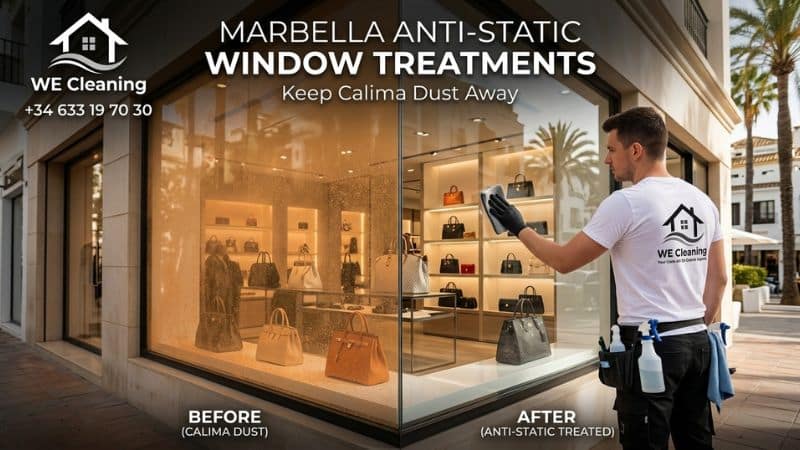
If you own a luxury boutique in Puerto Banús or manage a retail store along Avenida Ricardo Soriano, you know that keeping your display windows clean is a daily challenge.
You hire professionals to clean the exterior, but dust settles back on the glass within hours. This quick buildup is frustrating and negatively impacts how your products are displayed. The main issue isn’t just dirt blowing in from the street; it’s static electricity.
In this guide, we explain why commercial glass attracts dust and how to eliminate this static charge for good. We will compare structural window films and liquid nano-coatings and show how these treatments meet the specific challenges of Marbella’s coastal climate.
Why Storefront Glass Attracts Dust So Quickly
To reduce dust buildup on building glass, property managers should go beyond regular window washing and consider the properties of the glass itself.
The Science of Static Electricity on Glass
The main reason for quick dust buildup on cleaned glass is the triboelectric effect. Silica glass does not conduct electricity. When you wipe it with a dry synthetic cloth or drag a rubber squeegee across it, you remove electrons from the glass. This creates a strong positive charge on the surface.
Since glass can’t conduct electricity, this positive charge stays on the surface instead of spreading out. The charged glass acts like a magnet, pulling in neutral and negatively charged dust particles from the air. This attraction is why fine dust sticks to freshly cleaned windows within minutes.
The Marbella Factor: Calima and Coastal Salt
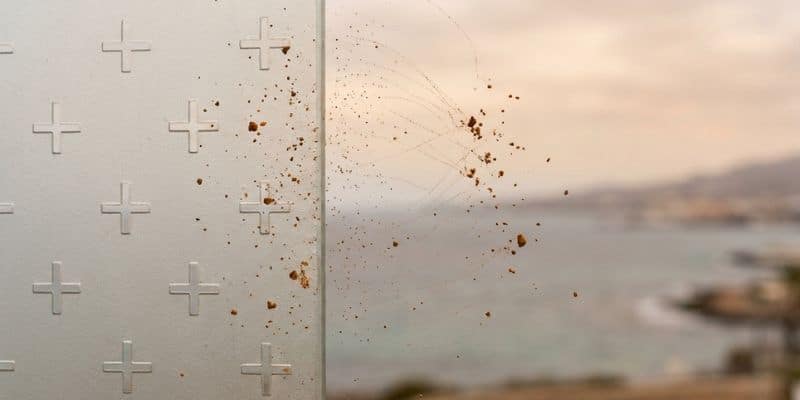
The Mediterranean climate of the Costa del Sol creates conditions that increase static dust attraction.
- The Calima Phenomenon: The Agencia Estatal de Meteorología (AEMET) says that Calima events bring in thick clouds of Saharan dust. This dust consists of tiny quartz and clay particles that easily attract static electricity.
- Dry Levante Winds: Hot and dry winds from the interior lower the humidity along the coast. Low humidity removes moisture from surfaces, which normally helps reduce static electricity. As a result, display windows become highly charged.
- Coastal Marine Aerosols: Salt mist from the Alboran Sea evaporates on warm glass, leaving behind sticky sodium chloride crystals that conduct electricity.
- Traffic Particulate: Stores near the A-7 highway or busy roads are constantly exposed to brake dust and tire particles in the air.
Managing these compounding environmental factors requires specialized intervention, much like the rigorous protocols required when deep cleaning homes after calima in Costa del Sol.
Top Anti-Static Window Treatments for Retailers
To reduce surface charges, retailers need to make their glass less resistive, bringing it into the static-dissipative range of 10⁸ to 10¹¹ Ω/sq. There are two main technologies available that can help with this retrofit.
Static-Dissipative Window Films (PET)
Anti-static window films are clear sheets made from polyethylene terephthalate (PET) that have a special coating to prevent static electricity. When used on storefronts, these films help safely release static charges into the air.
- Pros: They are very durable and can last between 3 to 7 years. They quickly eliminate static charges (usually in under 0.5 seconds) and block up to 99% of UV rays, which protects the items inside from fading in sunlight.
- Cons: Installing these films requires careful, professional work from edge to edge. If any dust gets trapped during the installation, it can damage the clarity of the film, resulting in a higher initial cost.
Liquid Sol-Gel Anti-Static Coatings
Liquid nano-coatings use a chemical blend, often with silane and conductive metal oxides, that bonds directly with glass silica molecules. This creates a very thin, static-dissipative layer on the glass without needing a physical film.
- Pros: This coating allows you to retrofit irregular glass surfaces, like curved displays or historic buildings, where applying a film is difficult. There is no risk of the edges peeling off.
- Cons: The coating has a shorter lifespan, usually needing reapplication every 12 to 18 months. Its thin layer can be damaged by rough cleaning. To protect the coating, strict cleaning protocols must be followed in your routine commercial cleaning.
Why Standard Hydrophobic Coatings Fail
Many contractors mistakenly recommend automotive-style “ceramic” coatings for retail storefronts. While these products are great at repelling rainwater, they can cause problems in dry coastal areas.
Feature | Hydrophobic (“Ceramic”) Coatings | True Anti-Static Treatments |
Primary Function | Repels water (high contact angle) | Lowers surface resistivity |
Dry Dust Adhesion | Often increases (acts as a strong electrical insulator) | Significantly decreases (neutralizes the magnetic pull) |
Ideal Climate | Heavy, frequent rain environments | Dry, dusty, and coastal environments |
Static Generation | High (especially when dry-buffed) | Near zero (dissipates static instantly) |
Typical fluoropolymer sprays are strong electrical insulators. In hot, dry summers in Andalusia, wiping down a hydrophobic coating creates a lot of static friction, which makes dry dust stick even more.
Protecting Visual Merchandising in Marbella
Upgrading your glass is more than just a maintenance task; it is a smart investment in how your retail brand looks.
Maintaining Optical Clarity and VLT
Visible Light Transmission (VLT) is the most important factor for luxury retail displays. High-end products need clear visibility without color distortion or surface haze. Premium anti-static treatments are designed to keep optical clarity above 99%. When used correctly, these treatments ensure the optical haze factor stays below 1%. This prevents high-intensity LED display lighting from causing a “milky” appearance or glare during nighttime viewing along the Golden Mile.
Reducing Commercial Cleaning Frequencies
The main benefit of anti-static treatment is that it greatly reduces maintenance costs for facilities. By neutralizing static, you can shift regular cleaning from costly daily washes to easier, lighter weekly rinses. This also means you will need to scrub less often, which helps prevent micro-scratches on the glass over time. This method of improving efficiency is similar to how housekeeping is streamlined in 10-room boutique hotels in Marbella Old Town.
How to Maintain Treated Storefront Windows
To protect your investment, property managers must follow strict maintenance rules. Using the wrong chemicals can quickly damage a static-dissipative hard coat.
Safe Non-Ionic Cleaning Protocols
- Rinse with De-ionized Water: Start by rinsing the glass with purified, de-ionized water. This removes loose particles without leaving hard-water stains or changing ionic charges.
- Use Non-Ionic Detergents: Clean the surface with neutral pH, non-ionic glass cleaners only. Avoid using ammoniated window sprays, acidic solutions, or strong alkaline degreasers, as these can permanently remove the conductive polymers from the surface.
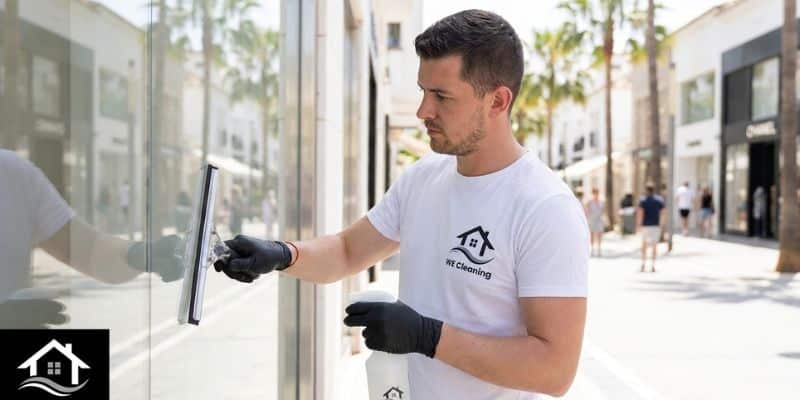
- Minimize Friction: Use soft neoprene or silicone squeegee blades. Do not let cleaning crews use abrasive pads or heavy-duty scrubbers. Following the right window cleaning methods will help extend the lifespan of the treatment.
Avoiding Abrasive Damage During Calima
Saharan dust contains quartz, which is a hard material with a Mohs hardness of 7. If you wipe heavy Calima silt off a dry window, you risk scratching the glass because the quartz particles can grind into the surface. An anti-static treatment helps the dust sit lightly on the surface by neutralizing its magnetic bond. During a dust event, use a gentle low-pressure rinse to wash the particles away. Understanding this mechanical interaction is essential, much like knowing the procedural differences between handling dry Calima vs. “lluvia de barro” on exterior facades.
Upgrading Your Marbella Storefront Glass
Electrostatic attraction, rather than just dirt from the street, is the main reason retail glass looks unclear. By treating your storefront to reduce its surface resistivity, you prevent the glass from attracting coastal dust and Calima silt. Investing in anti-static technology helps keep your displays clear, maintains your luxury look, and lowers your cleaning costs. If you notice dust returning quickly, check how often you clean and think about getting a professional cleaning service to upgrade your architectural glass.
FAQs About Anti-Static Glass Treatments
How long do anti-static window films last?
Commercial PET anti-static films typically maintain their static-dissipative properties for 3 to 7 years. Longevity depends heavily on the level of direct UV exposure and strict adherence to non-abrasive, chemical-free cleaning protocols.
Will anti-static treatments tint my glass?
Dedicated anti-static treatments are optically clear with extremely high Visible Light Transmission (VLT). However, if a boutique owner specifically wants to reduce solar heat gain, conductive anti-static topcoats can be manufactured over standard solar-control tints.
Can treatments stop all Calima dust buildup?
No treatment can defy gravity. While anti-static technology neutralizes the electrostatic force holding fine dust vertically against the glass, heavy windblown silt will still settle on window ledges, frames, and sills. The distinct advantage is that whatever dust lands on the glass will rinse off easily without aggressive scrubbing.
Are these safe for low-iron display glass?
Yes. Both premium clear PET films and liquid sol-gel coatings are fully compatible with ultra-clear, low-iron (Optiwhite) luxury retail glass. They do not introduce a green or yellow hue, preserving the high color-rendering index (CRI) required for fashion and jewelry displays.