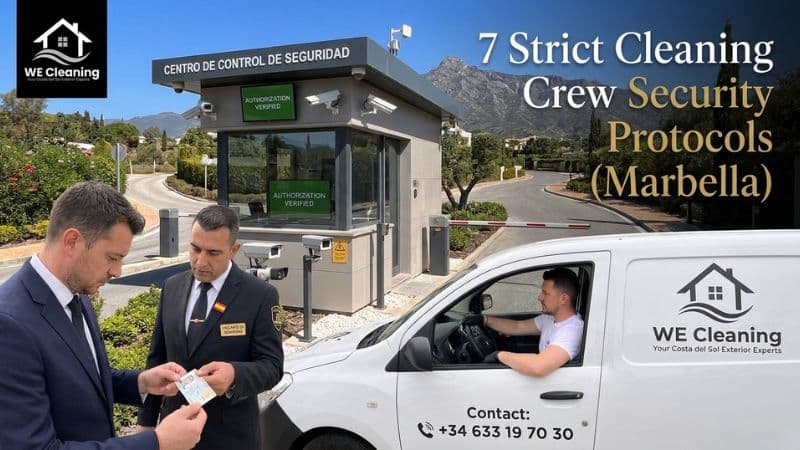
Allowing a cleaning or maintenance crew into a very rich person’s home requires complete trust and strict procedures. Regular cleaning practices don’t meet the high safety standards needed for private estates.
This guide explains the security steps cleaning crews must follow to protect valuable properties, important items inside, and the privacy of residents.
You will learn about identity checks before arrival, how crews enter the property, and rules for using smartphones on-site. Discover how these cleaning protocols work in exclusive areas like La Zagaleta in Benahavís and Sierra Blanca on Marbella’s Golden Mile.
Why Security Matters for Luxury Villas
In the luxury housing market of Marbella, professional housekeeping is essential for managing risks to valuable estates. High-end villas contain unique architectural features, custom furniture, and expensive art collections that need careful handling.
When outside vendors enter a property, any mistakes in protocol can lead to unauthorized access, accidental damage, or threats to privacy. Many standard cleaning companies use informal staff and basic keys, which creates serious risks.
Professional security systems ensure that every worker entering the property is vetted, monitored, and follows all legal requirements. They also agree to keep all information confidential.
Asset Protection and Client Privacy
Working in a high-net-worth individual (UHNWI) estate comes with ongoing exposure to sensitive situations. Open doors and unsealed entrances can create security risks if technicians are not trained in surveillance and aware of their surroundings.
Estate housekeeping relies on three main security principles:
- Physical Access Control: Limit movement to only authorized areas and keep the property secure at all times.
- Digital and Personal Privacy: Implement strict policies to avoid recording or sharing data about property layouts, art collections, or the family’s schedule.
- Asset Preservation: Protect delicate materials—like marble, travertine, bronze fixtures, and fine upholstery—by following safe handling procedures to avoid damage.
For estate managers looking for better operational practices, our cleaning guide for Marbella property owners offers useful tips to align vendor services with long-term asset care.
Core Access Protocols for Cleaners
To secure a gated estate, there must be a clear process that starts before any service vehicle reaches the security checkpoint. Professional cleaning companies use a step-by-step approach to ensure that every team member arriving on-site has proper authorization and verified credentials.
Pre-Arrival Staff Vetting
Cleaning a villa requires administrative clearance that starts 24 to 48 hours before any physical cleaning. The service provider’s operations coordinator must send an official pre-authorization list directly to the Villa Manager and the community security office (Centro de Control de Seguridad).
This list must include specific and verified information:
- Staff Roster: Full legal names of all assigned technicians. No subcontractors or unannounced replacements are allowed.
- Official ID: Valid Spanish National Identity Cards (DNI), Foreigner Identification Numbers (NIE), or verified passports for every technician.
- Vehicle Information: Make, model, branding details, and license plate number of the service van being used.
- Work Details: Exact entry times, estimated work duration, and specific areas (interior or exterior) scheduled for cleaning.
If there are last-minute changes due to employee absence, an updated official list must be sent through the proper channels. If a cleaner arrives without prior clearance, estate security will refuse entry immediately.
Gatehouse Checkpoints and ID Rules
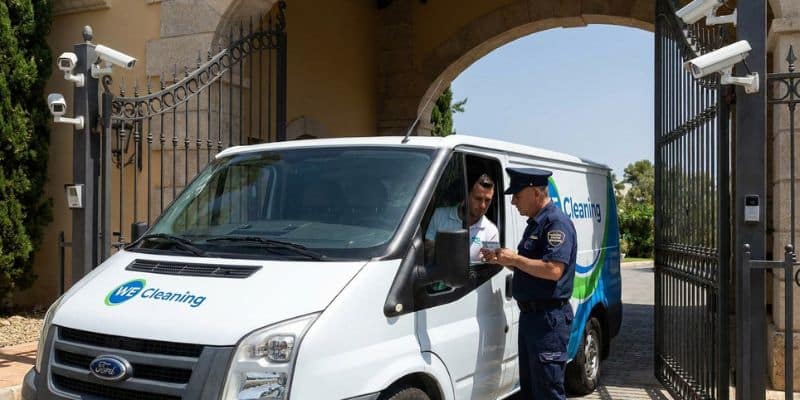
Upon arrival at the urbanization perimeter—such as the South Gate (Puerta Sur) or North Gate (Puerta Norte) of La Zagaleta, or the security gates of Sierra Blanca—the vehicle enters the dedicated commercial service lane.
Licensed private security guards (Vigilantes de Seguridad), operating under Spain’s Ley 5/2014 de Seguridad Privada, carry out physical and digital verification:
- License Plate Recognition (LPR): Automated optical cameras scan the commercial vehicle’s plate against the daily pre-authorized contractor database.
- Physical Credential Inspection: Each crew member must step forward and present their original physical photo ID (DNI, NIE, or passport). Driving licenses, photocopies, or digital phone screenshots are not accepted at top-tier security booths.
- Issuance of Temporary Passes: Once identity and manifest details align, guards log the vehicle’s arrival timestamp and issue temporary contractor passes or scannable visitor credentials that must be displayed visibly at all times while within the urbanization.
Key Custody and Smart Alarms
After passing through the perimeter gatehouse, the cleaning supervisor manages access to the property with the help of the estate staff or automated systems:
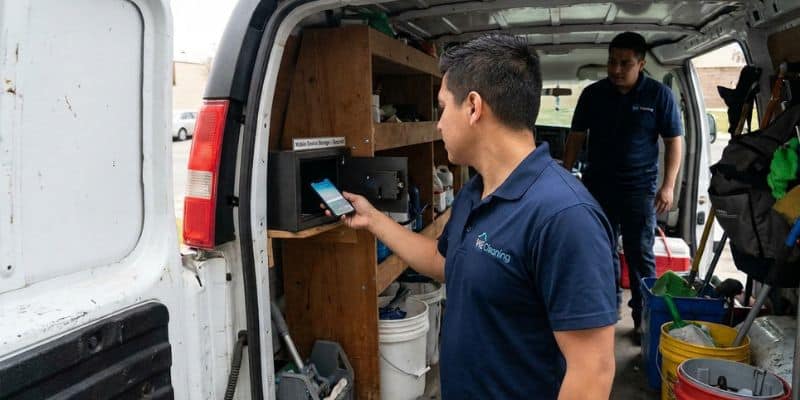
- Electronic Key Safes: When the property owner or villa manager is absent, workers take physical keys from high-security digital lockboxes near service entrances. Access codes for these keys are single-use or changed immediately after each service.
- Zero Off-Site Transport: Keys never leave the estate’s perimeter. They are either returned to the secure key safe or handed back to the villa concierge at the end of the shift.
- Multi-Partition Alarm Interfacing: Modern luxury estates use integrated smart home systems like KNX, Lutron, or Crestron. The cleaning supervisor enters a special vendor code to disarm only the areas scheduled for service, such as service corridors, living areas, and kitchen wings. Areas like perimeter beams, safe rooms, private offices, and primary bedrooms stay fully armed.
On-Site Operational Security
Controlling who enters the villa is just part of the task; ensuring good behavior inside is also crucial. When cleaning teams work in high-value properties, clear rules help avoid mistakes and protect the privacy of the residents.
Zonal Cleaning and Restricted Areas
Professional housekeeping teams use a “zonal containment” strategy. Instead of spreading out across a large home at once, the team works together in specific areas or levels.
They keep doors to private bedrooms, dressing rooms, offices, and art storage locked unless they are hired to clean those spaces. During special residential cleaning services, technicians keep outside doors shut to prevent unauthorized entry or drafts. This helps avoid triggering motion sensors inside the home.
Smartphone Embargos and Strict NDAs
Personal smartphones are a major security risk on high-security properties. This is due to issues like geolocation tagging, cloud photo backups, and accidental social media posts.
To reduce this risk:
- Personal Phone Policy: Technicians must keep their personal mobile devices in a locked service vehicle before entering the villa.
- Supervised Communication: Only the team supervisor can use a company-registered phone to communicate with the Villa Manager. Camera lenses should stay covered or be used only for necessary inspections before work starts.
- Non-Disclosure Agreements (NDAs): Every cleaner must sign a confidentiality agreement. These agreements prevent them from sharing information about property locations, building layouts, interior artwork, vehicle collections, camera placements, or the identities of residents and visitors.
Incident Reporting and Breakages
Even with experienced technicians, handling delicate luxury surfaces requires clear steps when something goes wrong. If a hidden scratch, marble acid etch, mechanical issue, or accidental breakage happens, the team follows this process:
- Stop Work Immediately: Technicians pause all work in the affected room.
- Keep the Scene Intact: Staff do not touch or move any items or fragments, keeping the area unchanged for inspection.
- Document the Condition: The supervisor uses the official company device to record the situation, making sure not to include any personal items in the photos.
- Report the Incident: The supervisor calls the Villa Manager or Estate Director within 15 minutes to inform them of the incident. They then write a formal report that includes timestamps, names, and specific details of what happened.
Community-Specific Access Rules
Access protocols on the Costa del Sol are very different depending on the area. A large residential area on the hillside has different security and environmental rules compared to a compact urban neighborhood. Recognizing these local differences shows real experience in operations.
Operational Feature | La Zagaleta (Benahavís) | Sierra Blanca (Marbella) |
Municipal Jurisdiction | Municipality of Benahavís | Municipality of Marbella |
Access Corridors | A-397 Ronda Mountain Road | Golden Mile connector roads, foot of La Concha |
Perimeter Configuration | ~900 hectares of private hillside reserve | Densely clustered urban luxury urbanization |
Internal Drive Times | 10–15 minutes from gatehouse to villa | 1–3 minutes from gatehouse to villa |
Internal Speed Limits | Strictly enforced 30–40 km/h; mobile radar | Standard residential limits; strict curb parking rules |
Noise & Machinery Rules | Daylight contractor hours; wildfire precautions | Strict community quiet curfews; low-decibel equipment |
Navigating La Zagaleta Logistics
La Zagaleta is in Benahavís and can be reached by the winding A-397 road from San Pedro de Alcántara to Ronda. This private area covers nearly 900 hectares of protected oak and pine valleys and requires careful planning for operations.
Contractor vehicles use specific gates depending on their destination and the urbanization guidelines. The distance between the gatehouses (Puerta Sur and Puerta Norte) and some hillside properties can be several kilometers.
Cleaning teams should plan for 10 to 15 minutes of travel time, keeping to a strict speed limit of 30 to 40 km/h. Private security patrols monitor internal roads, and speeding will lead to immediate revocations of entry.
Since the properties in La Zagaleta are close to natural reserves, cleaning vans must park entirely within the private motor court and cannot use community roads.
This rule helps maintain clear sightlines for mobile patrols. It is important to choose a cleaning service provider who understands these logistics, as explained in our guide on selecting the right cleaning service for luxury villas.
Sierra Blanca Urban Security
Sierra Blanca is a luxury neighborhood located at the base of La Concha mountain, just above Marbella’s Golden Mile. Unlike the large, rural hillside estates in Benahavís, Sierra Blanca has a high density of homes.
Security in Sierra Blanca focuses on keeping the area safe and private. Here are some key points:
- Discreet Parking: Streets like Calle James Stirling and Calle Albinoni must stay clear for community patrols and residents. Vans should be parked out of sight on private driveways.
- Noise Rules: Since homes share walls, there are strict noise rules. You cannot use loud equipment like pressure washers or vacuum extractors before the designated morning hours.
- Fast Response: Because Sierra Blanca is close to central Marbella, private security and local police can respond to alarms or potential break-ins within 3 to 5 minutes.
Spanish Legal and Insurance Compliance
Good operational security depends on following the law. Hiring unregistered cleaners or informal domestic workers can lead to serious legal risks for property owners under Spanish labor and liability laws.
Workplace Safety and CAE Regulations
Under Spanish labor law, property managers and community associations must ensure that external service contractors follow workplace safety regulations.
The main rule for third-party contractors is the Coordinación de Actividades Empresariales (CAE), set by Real Decreto 171/2004, which is based on Article 24 of Ley 31/1995 de Prevención de Riesgos Laborales (PRL).
Before the estate security allows access, the cleaning company must show proof that all workers:
- Are registered with the Spanish Social Security system (Alta en la Seguridad Social).
- Have received certified training in safety practices related to handling chemicals, operating heavy machinery, and working at heights (such as mezzanine balustrades and architectural chandeliers).
- Have appropriate Personal Protective Equipment (PPE) and Material Safety Data Sheets (Fichas de Datos de Seguridad) for all products used on-site.
Allowing workers who are not compliant or declared onto private property can lead to legal and administrative responsibility for the estate owner if an accident occurs on the premises.
High-Value Public Liability Coverage
Standard commercial insurance policies for small offices or regular apartments do not provide enough coverage for high-value homes. A professional cleaning company working in Sierra Blanca or La Zagaleta needs to carry a comprehensive public liability insurance policy. This insurance should cover between €1,000,000 and €5,000,000 to match the luxury of these homes.
This insurance protects homeowners against rare but serious incidents, such as:
- Accidental chemical damage to delicate, unsealed Italian marble or microcement floors.
- Water leaks from accidentally disconnecting equipment during deep cleaning.
- Damage to expensive architectural glass, solar shading motors, or fragile art pieces.
Secure Your Marbella Estate Cleaning
Taking care of a luxury villa in Marbella or Benahavís requires a strong focus on security, privacy, and following the law. Regular housekeeping services often can’t provide the thorough vetting, access management, and careful operations needed in gated communities like Sierra Blanca and La Zagaleta.
At WE Cleaning, our staff members are directly hired, background-checked, and trained to respect your privacy. Contact us today to schedule professional cleaning services in Costa del Sol and Marbella that meet your estate’s security needs.
FAQs About Estate Cleaning Security
How are unauthorized workers handled?
If a cleaner arrives at a gated community checkpoint and their name, national identity document (DNI/NIE/passport), or vehicle plate does not match the pre-authorized manifest submitted to the security office, they are turned away immediately. Private security guards at urbanizations like Sierra Blanca or La Zagaleta will not accept verbal authorizations from the driver.
What happens if an alarm is triggered?
If an internal alarm sensor or perimeter beam is tripped accidentally during a clean, the cleaning supervisor immediately contacts the Villa Manager and estate concierge. The supervisor remains in the service courtyard with company credentials and photo identification visible, ready to interface directly with the armed response patrol or the Policía Local, preventing unnecessary emergency escalations.
Are cleaning vehicles tracked on-site?
Yes. Aside from company-installed GPS tracking on commercial service vans, high-security communities utilize network-connected License Plate Recognition (LPR) cameras and mobile patrols to monitor vehicle transit. Commercial vehicles must proceed directly to the designated villa and park within the estate’s private motor court.
How is key handover managed safely?
Keys are never transferred off-site or handled through unsecured messaging. Custody follows strict physical protocols: keys are retrieved from a dual-custody digital safe located on the property or signed out from the urbanization concierge, and they are returned and audited immediately upon completion of the service.